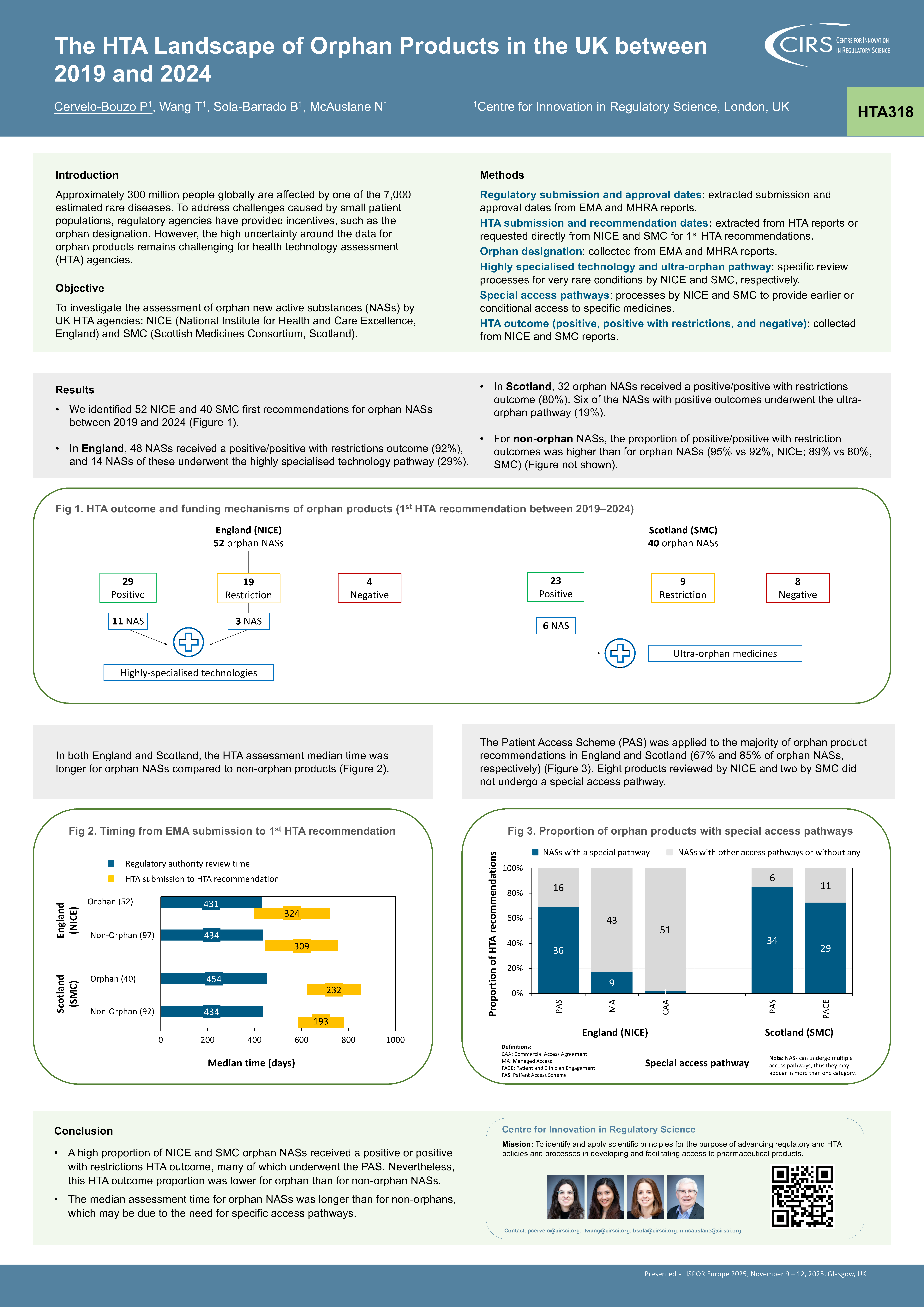
To mark Rare Disease Day on 28 February, we’re sharing findings from our work examining how orphan new active substances (NASs) are assessed by two of the UK’s HTA agencies — NICE in England and the Scottish Medicines Consortium (SMC) — between 2019 and 2024. This research was originally presented as a poster at ISPOR Europe 2025.
As part of our comparative HTA research, we analysed timelines, recommendations and the use of special access pathways to help build a clearer picture of how orphan medicines move through these distinct systems.
Key insights from our analysis:
- 52 orphan NASs received a first NICE recommendation; 40 received a first SMC recommendation
- Positive or positive-with-restrictions outcomes were issued for 92% of orphan NASs at NICE and 80% at SMC
- Special access pathways were widely used — including the Patient Access Scheme (PAS) at NICE (67%) and SMC (85%), and Patient and Clinicians Engagement (PACE) pathway at SMC (73%)
- Median assessment times were longer for orphan NASs than for non-orphan NASs across both agencies, which may be due to the need for specific access pathways.
As we recognise the experiences of the 300 million people worldwide living with a rare disease, we hope these findings contribute to ongoing discussions on how HTA pathways can continue to support timely access to treatments for rare conditions.
This poster was presented by Penelope Cervelo at ISPOR Europe 2025, 9-12th November 2025, Glasgow, UK.
Conference abstract
Objectives: Approximately 300 million people, globally, are affected by one of the 7,000 estimated rare diseases. Regulatory agencies have provided incentives to address challenges caused by small patient populations. However, the high uncertainty around their data remains challenging for Health Technology Assessment (HTA) agencies. This study aims to investigate how UK HTA agencies assess orphan New Active Substances (NAS).
Methods: Time and 1st outcome of HTA assessments for orphan and non-orphan NASs (UK-designated) were collected from NICE and SMC websites between January 2019 and December 2024. Additionally, SMC kindly provided their HTA submission dates.
Results: We identified 52 NICE and 40 SMC assessments for orphan NASs between 2019 and 2024. In England, 48 received a positive or positive with restrictions outcome (92%), and 14 NASs of these underwent the highly specialised technology pathway (29%). In Scotland, 32 orphan NASs received a positive or positive with restrictions outcome (80%), and 22 underwent the orphan and ultra-orphan pathway (69%). In both England and Scotland, the HTA assessment time was longer for the orphan NASs compared to non-orphan products (England, 447 vs 331 days; Scotland, 242 vs 193 days). The Patient Access Scheme (PAS) was applied for the majority of the recommendations in England and Scotland (67% and 85% of orphan NASs, respectively).
Conclusions: A high proportion of NICE and SMC orphan NASs received a positive or positive with restrictions HTA outcome, predominantly enabled by the PAS. However, the assessment time for orphan NASs is longer than non-orphans which may be due to the need for different procedural processes.