Overview
Health technology assessment (HTA) plays a key role in supporting evidence-informed healthcare decision making, pricing, reimbursement, and coverage decisions worldwide. As countries seek to strengthen health policy and resource allocation processes, understanding how HTA systems are organised and integrated into decision-making processes has become increasingly important.
This comparative review—co-authored by CIRS’ HTA Lead Dr Tina Wang— examines ten HTA systems across Europe, North America, Asia and Latin America and explores how differences in governance, institutional arrangements and policy integration shape the role of HTA in healthcare systems.
The authors used a five-module framework based on the World Health Organization’s approach to HTA institutionalisation. The analysis examined governance structures, assessment and appraisal processes, institutional roles, stakeholder engagement, and the integration of HTA into coverage, pricing, and lifecycle management decisions.
The authors found substantial variation in HTA governance, scope, authority, and policy integration across jurisdictions. The study highlights how institutional design can influence the role of HTA in decision making and identifies lessons that may support countries seeking to establish, strengthen, or reform HTA systems. Key areas for development include institutional capacity, methodological rigour, transparency, stakeholder engagement, and lifecycle approaches to technology assessment.
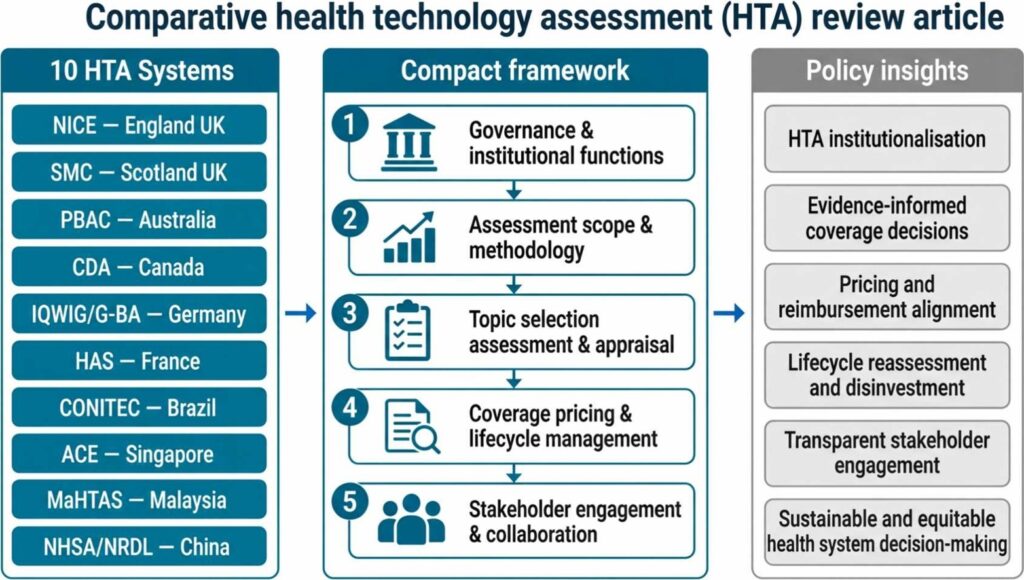
Graphical abstract illustrating the framework used to compare 10 HTA systems across Europe, North America, Asia and Latin America.
Source: Dai Z, Cheung EKY, Wang T et al. Comparative review of selected health technology assessment agencies: Features and insights for health technology assessment development and improvement. Pharmacoeconomics and Policy (2026). DOI:10.1016/j.pharp.2026.06.007.
Key Findings and Implications
-
HTA systems differ widely in governance, organisational structure, and integration into health policy processes.
-
Institutional design influences the breadth of HTA roles in healthcare decision making.
-
Approaches to assessment, appraisal, pricing, reimbursement, and stakeholder engagement vary across jurisdictions.
-
Comparative lessons can inform the development and reform of HTA systems in both established and emerging settings.
-
Strengthening institutional capacity, methods, transparency, and stakeholder engagement may help improve HTA effectiveness and sustainability.
HTA systems included in this review
This review compares ten HTA systems across Europe, North America, Asia and Latin America, including:
-
National Institute for Health and Care Excellence (NICE), England
-
Scottish Medicines Consortium (SMC), Scotland
-
Canada’s Drug Agency (CDA-AMC), Canada
-
Pharmaceutical Benefits Advisory Committee (PBAC), Australia
-
Institute for Quality and Efficiency in Health Care (IQWiG) and Federal Joint Committee (G-BA), Germany
-
Haute Autorité de Santé (HAS), France
-
National Committee for Health Technology Incorporation into the Unified Health System (CONITEC), Brazil
-
Agency for Care Effectiveness (ACE), Singapore
-
Malaysian Health Technology Assessment Section (MaHTAS), Malaysia
-
National Healthcare Security Administration (NHSA) reimbursement process, China