Overview
Between January 2025 and June 2026, 20 medicinal products entered the EU Joint Clinical Assessment (JCA) process, including seven medicines developed primarily by Chinese companies. These products represent some of the first opportunities to examine how different internationalisation strategies may influence preparedness for European health technology assessment (HTA).
Drawing on publicly available evidence, this CIRS Insight explores how China-origin medicines have expanded internationally, the differing development and licensing pathways used, and the potential implications of these approaches for JCA and broader HTA readiness.
What is a China-origin medicine?
For the purposes of this analysis, a China-origin medicine is defined as a product for which a Chinese company held primary responsibility for clinical development and initial registration in China, irrespective of where the molecule was originally discovered or whether it was subsequently licensed, partnered, or co-developed internationally.
Key findings
China-origin medicines are reaching Europe through increasingly diverse internationalisation strategies
The first wave of China-origin medicines entering JCA demonstrates that there is no single pathway from domestic approval to global expansion. Companies are pursuing a range of approaches, from sequential China-first development and licensing partnerships to more globally integrated development programmes.
Internationalisation is shaping the evidence available for European decision making
The products analysed differ not only in their commercial and development strategies, but also in the way evidence has been generated to support regulatory and HTA submissions. These differences may influence the evidence available for European assessment and decision making.
JCA provides a new lens through which to assess HTA readiness
While evidence generated predominantly in China has supported European regulatory approvals, JCA introduces additional considerations relating to comparative effectiveness, methodological transparency, and alignment with European healthcare settings. This may make HTA readiness an increasingly important consideration in internationalisation planning.
Internationalisation timelines
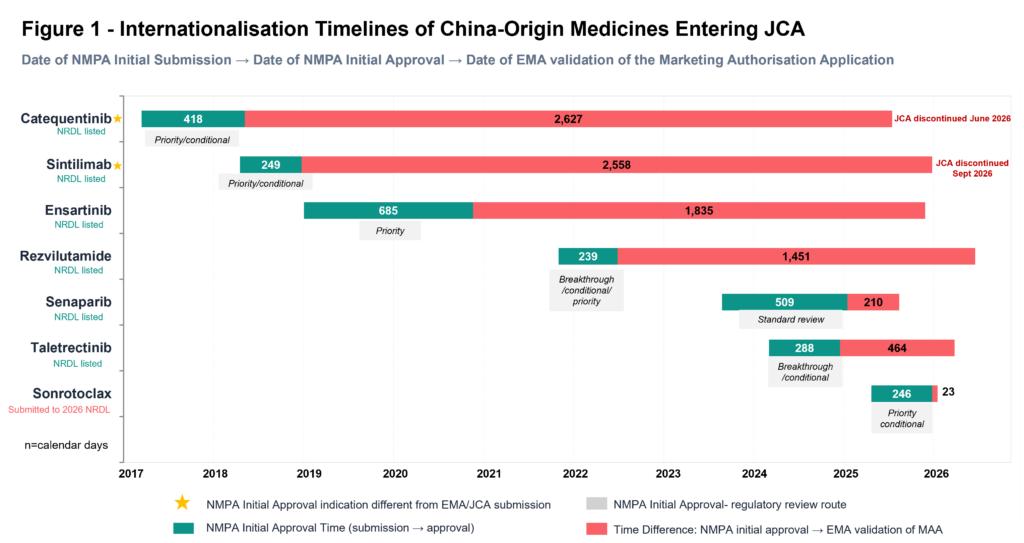
One notable observation is the heterogeneity in timelines between initial approval in China and entry into the European regulatory and HTA environment. Among the seven products examined, the interval between NMPA approval and EMA submission ranged from less than one month to more than seven years. Figure 1 illustrates the diversity of these internationalisation trajectories.
These differing timelines suggest that China-origin medicines are not following a single trajectory from domestic approval to overseas expansion. Instead, multiple approaches to internationalisation are emerging.
Internationalisation pathways in practice
The products examined illustrate a variety of approaches to internationalisation, including China-first development followed by expansion through licensing and partnerships, international growth led directly by Chinese companies, and more integrated global development programmes.
These approaches may influence not only commercial strategy but also the design of clinical development programmes, the timing of evidence generation, and the evidence available to support regulatory and HTA submissions.
A comparison of the seven products highlights how different development, licensing and commercialisation models are being used to support international expansion.
What could this mean for HTA readiness?
Previous EMA approvals have demonstrated that evidence generated predominantly in China can support European regulatory decision making when study design, data quality and clinical outcomes are considered robust and relevant. However, JCA places greater emphasis on comparative clinical effectiveness within specific healthcare settings.
The discontinuation of the JCA procedures for catequentinib and sintilimab provides early examples of the importance of evidence synthesis, methodological transparency and alignment with JCA requirements. Published European Commission documentation identified deficiencies relating to evidence identification, comparative analyses, supporting documentation and reporting.
These observations suggest that successful participation in JCA may depend not only on generating high-quality clinical evidence, but also on planning for HTA requirements earlier in product development and internationalisation strategies.
Looking ahead
The first wave of China-origin medicines entering JCA illustrates the emergence of diverse approaches to pharmaceutical internationalisation, ranging from China-first development and subsequent expansion to globally integrated development programmes. These approaches differ not only in commercial structure but also in the timing and maturity of the evidence available for European regulatory and HTA review.
JCA provides a new lens through which to examine whether different internationalisation strategies generate evidence that is fit for European HTA requirements. As more products enter the procedure, understanding how development and internationalisation choices influence HTA readiness may become increasingly important for companies seeking successful market access in Europe.