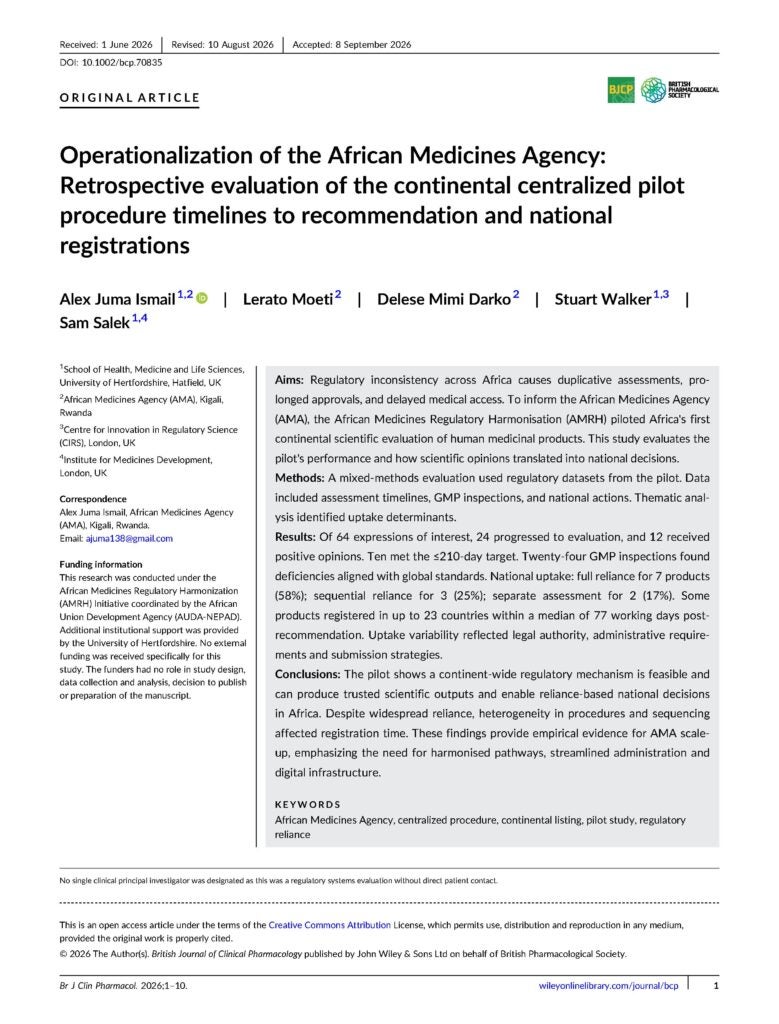
This study co-authored by CIRS, the African Medicines Agency (AMA), and University of Hertfordshire, provides the first empirical evaluation of a continental centralised procedure for the scientific assessment and listing of human medicinal products in Africa.
Published in the British Journal of Clinical Pharmacology, the research evaluates the performance of the continental listing pilot implemented by the African Medicines Regulatory Harmonization (AMRH) initiative between 2023 and 2025. It examines the time taken to reach continental scientific recommendations, the subsequent uptake of those recommendations by national regulatory authorities and the factors influencing national uptake.
The pilot was established to test core functions anticipated for AMA, including joint scientific assessment, coordinated Good Manufacturing Practice inspections and reliance-based national decision making. The continental procedure produced a consolidated scientific opinion but did not grant marketing authorisation, which remained the responsibility of individual national regulatory authorities.
Download the journal article to explore the full findings
Continental assessment met its target for most listed products
Of the 24 products that underwent continental evaluation, 12 received a positive scientific opinion and were included in the continental list (known as the Green Book). Ten of these 12 products (83%) met the target of no more than 210 working days from dossier acceptance to continental listing.
The pilot also included 24 GMP inspections associated with the evaluated products. These used onsite, remote and desk-based approaches selected according to risk and site accessibility. Twenty-three inspections were completed, with no critical deficiencies identified.
National uptake reflected different approaches to reliance
National regulatory authorities adopted different approaches to reliance following continental listing. Seven of the 12 listed products (58%) were processed through full reliance resulting in immediate national registration, while three (25%) received supplemented reliance involving additional national queries or procedural steps. Two products (17%) underwent national review after the continental assessment.
For the 12 countries with documented post-listing decision dates, the median time from continental listing to a national decision was 77 working days, with timelines ranging from 11 to 116 working days. The analysis associated this variation with differences in national legal frameworks, administrative requirements, the sequencing of national submissions and the way reliance pathways were implemented.
Implications for the African Medicines Agency
The findings demonstrate that a continent-wide scientific assessment and listing mechanism is feasible and can produce scientific outputs that support reliance-based national decisions.
The study also identifies areas that will be important as AMA moves towards full operationalisation. These include:
- embedding reliance pathways in national legislation and standard operating procedures
- reducing delays associated with administrative and governance processes
- strengthening coordinated, risk-based GMP inspection capacity
- implementing the governance and digital systems needed for efficient cross-country coordination.
The study also highlights the need for continued evaluation as the African Medicines Agency becomes fully operational, including research into product availability and wider public health outcomes.