
UMBRA Benefit-risk Framework
Goal/purpose
Enable a systematic approach to benefit-risk decision making
Overview
The Unified Methdologies for Benefit-Risk Assessment (UMBRA) framework provides a structured, transparent approach for evaluating the benefits and risks of medicines during regulatory assessment. It guides assessors through the key steps of defining the decision context, characterising evidence, weighing uncertainties, and articulating the rationale behind final decisions. The accompanying template supports clear, consistent documentation and helps ensure that benefit–risk considerations are communicated in a logical and reproducible manner. Regulatory agencies use the UMBRA framework and template to strengthen the quality, transparency, and predictability of their product evaluations.
Who UMBRA is for
Any regulatory agency, regardless of size or maturity, can use the UMBRA framework and template.
How UMBRA works
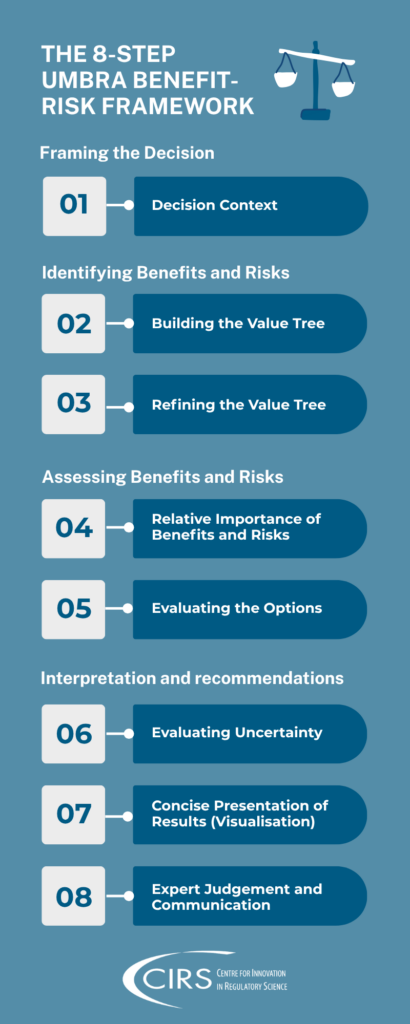
The UMBRA framework is divided into eight steps to frame the decision, identify the benefits and the risks, assess those benefits and risks, and interpret them to make recommendations (see graphic, right).
The UMBRA template follows this framework and is completed by agency assessors for specific products. The completed templates can inform internal and external discussions on benefit risk, including interactions with companies, and with other agencies in the case of risk-based reliance reviews and work sharing. They can also serve as the basis for public assessment reports.
Practical use cases
The UMBRA framework and template have been used by regulators in Asia, Africa, Australia, North and South America, Europe, and the Middle East in various ways:
- Retrospective and prospective case studies on the benefit-risk assessment of medicinal products
- Modifying clinical assessment templates
- Ensuring alignment of processes compared to other agencies
- Facilitating risk-based reliance reviews and work sharing
- As a reviewer training tool to support structured systematic reviews.
WHO Global Benchmarking Tool (GBT) indicators supported by UMBRA
- GBT RS09.03: Information on decisions related to regulatory activities is available to the public
- GBT RS03.04: Reliance on the decisions of other mature NRAs through documented policy, procedures, and/or mechanisms must be formalised
- GBT MA05.03: NRAs are required to publish the summary technical evaluation reports for approved applications of marketing authorisation in the public domain
Resources
- Walker, S., McAuslane, N., Liberti, L. et al.A Universal Framework for the Benefit-Risk Assessment of Medicines: Is This the Way Forward?. Ther Innov Regul Sci 49, 17–25 (2015)
- CIRS 2015 Workshop Report – Utilisation of a common benefit-risk framework
- Danks L, Semete-Makokotlela B, Chuma D, et al. The value of a structured, systematic approach to benefit-risk assessment of medicines: A South African regulator case study. Regul Toxicol Pharmacol. 2025;162:105893.
- Chisha CS, Leigh S, Mubanga PM et al. An evaluation of the use of the Universal Benefit-Risk Assessment Framework by the Zambia Medicines Regulatory Authority for documenting and communicating benefit-risk decisions. Regulatory Toxicology and Pharmacology. 2026;172:106204.
- Keyter A, Salek S, Banoo S, Walker S. Can Standardisation of the Public Assessment Report Improve Benefit-Risk Communication?. Front Pharmacol. 2020;11:855. Published 2020 Jun 17.
- CIRS R&D Briefing 87: Roadmap for Regulatory Strengthening: CIRS Tools for Measuring and Optimising Regulatory Performance to support practices in line with the World Health Organization (WHO) Global Benchmarking Tool (GBT) indicators
- CIRS benefit-risk publications