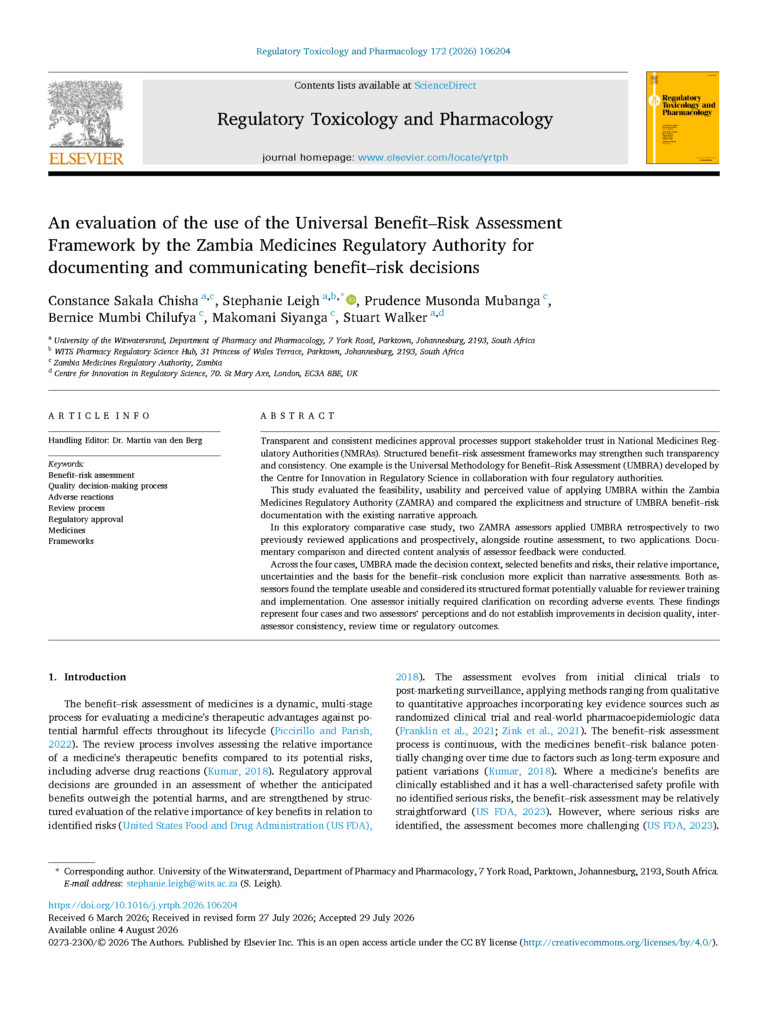
Transparent and consistent benefit-risk assessment is fundamental to regulatory decision making and stakeholder confidence in medicines regulation. This study evaluated the application of the Universal Methodology for Benefit-Risk Assessment (UMBRA) within the Zambia Medicines Regulatory Authority (ZAMRA), examining the usability and value of the structured framework in the documentation and communication of benefit-risk decisions.
Through retrospective assessments of previously reviewed medicine applications and prospective assessments conducted alongside the review of new applications, the study compared the UMBRA structured benefit-risk assessment framework with ZAMRA’s existing narrative assessment approach. The findings suggest that UMBRA enabled more explicit documentation of the decision context, key benefits and risks, uncertainties, and the rationale underpinning regulatory recommendations. Assessors also reported that the framework could support reviewer training, transparency, and future implementation of regulatory reliance practices.
Download the journal article to explore the full findings
Key findings
- UMBRA provided a more structured and transparent approach to documenting benefit-risk assessments than ZAMRA’s existing narrative method.
- Assessors found the framework feasible to apply to both retrospective and prospective medicine reviews.
- The framework was perceived as valuable for reviewer training, documentation consistency, and regulatory reliance.
-
The study recommends further evaluation of UMBRA to support its potential integration into routine assessments, assessor training, and public assessment reporting.
About UMBRA
The Universal Methodology for Benefit-Risk Assessment (UMBRA) is a benefit-risk framework developed by the Centre for Innovation in Regulatory Science (CIRS) in collaboration with regulatory agencies. The approach aims to support transparent, structured, and consistent benefit-risk assessment and communication.
The UMBRA framework is divided into eight steps to frame the decision, identify the benefits and the risks, assess those benefits and risks, and interpret them to make recommendations. The UMBRA template follows this framework and is completed by agency assessors for specific products.
A similar study conducted within the South African regulatory agency, SAHPRA, showed that using the UMBRA template alongside SAHPRA’s standard template could improve SAHPRA’s decision-making processes, providing better rationalisation for decisions and facilitating alignment with other regulatory authorities while allowing for local contextualisation.