
Twenty years ago, participants at a CIRS workshop explored ideas that at the time appeared ambitious, including rolling reviews, facilitated regulatory pathways, collaborative assessments and real-time data sharing. Many of these concepts are now embedded within regulatory practice around the world.
CIRS R&D Briefing 44 summarised discussions and recommendations from the May 2004 CMR International Institute for Regulatory Science (now CIRS) forward-looking workshop in Tokyo, Japan, which brought together senior representatives from regulatory agencies and the pharmaceutical industry. The discussions centred on the need for a new paradigm in global drug development and regulatory review, one that would better align with evolving patient needs, and the increasing complexity of emerging technologies.
Twenty years on, many of its recommendations have been implemented in today’s regulatory landscape, while others continue to inspire innovation and reform.
Facilitated regulatory pathways: From concept to practice
Rolling reviews with early regulatory engagement were among the most forward-thinking proposals from this workshop; participants envisioned a model where scientific advice is sought at the beginning of clinical development, with regulatory agencies evaluating data earlier and on a continuous basis, rather than assessing the full dossier at the completion of phase III. This model also explored the potential for early marketing of a novel medicine addressing unmet medical needs under controlled conditions when sufficiently robust supporting data was confirmed at the end of phase II. The medicine would then move to a full marketing authorisation under normal conditions based on fulfilment of an agreed post-marketing programme.
Over the last two decades since the workshop, major regulatory agencies globally have established facilitated regulatory pathways (FRPs) to accelerate product development, market authorisation application submissions, or regulatory reviews. Data from our agency benchmarking R&D Briefings show that FRPs are currently integral to regulatory strategies, particularly for products addressing serious conditions and unmet medical needs. The workshop’s vision of more flexible and adaptive approvals with real-world data collection is now reflected in the increased use of FRPs and post-marketing evidence generation.
Central data storage for real-time access
The vision for a centralised data warehouse—an electronic platform enabling real-time access to product dossiers —has become partly become a reality through cloud-based platforms, such as the Accumulus platform. This was recently discussed at our collaborative models workshop in South Africa. Several proof-of-concept projects across multiple jurisdictions demonstrate support for regulatory reliance by facilitating real-time collaboration between industry and regulators, as well as among regulators. Scaling this model globally could unlock unprecedented efficiencies in regulatory collaboration and reliance.
Collaborative reviews
The 2004 workshop advocated for joint coordinated reviews with the potential for recognition of the assessment of Chemistry, Manufacturing and Controls (CMC) and nonclinical data across agencies. As regulatory standards have become increasingly harmonised and trust has been built between regulators, the concept of collaborative review gained traction and has become reality in the form of initiatives such as:
- 2007 – Access Consortium, now facilitating work sharing among five regulatory authorities (Australia, Canada, Singapore, Switzerland and UK).
- 2009 – African Medicines Regulatory Harmonisation initiative, supporting regional joint assessments in Africa and laying the groundwork for the African Medicines Agency established in 2021.
- 2016 – Caribbean Regulatory System, providing recommendations for market authorisation, rational use, and quality and safety monitoring of medical products in the Caribbean.
- 2017 – ASEAN Joint Assessment, enabling collaborative product evaluations across ASEAN member states (Brunei, Cambodia, Indonesia, Laos, Malaysia, Myanmar, the Philippines, Singapore, Thailand and Vietnam).
- 2019 – Project Orbis, enabling concurrent submission and review of oncology products across multiple countries (currently Australia, Brazil, Canada, Israel, Singapore, Switzerland, and UK) led by the US FDA.
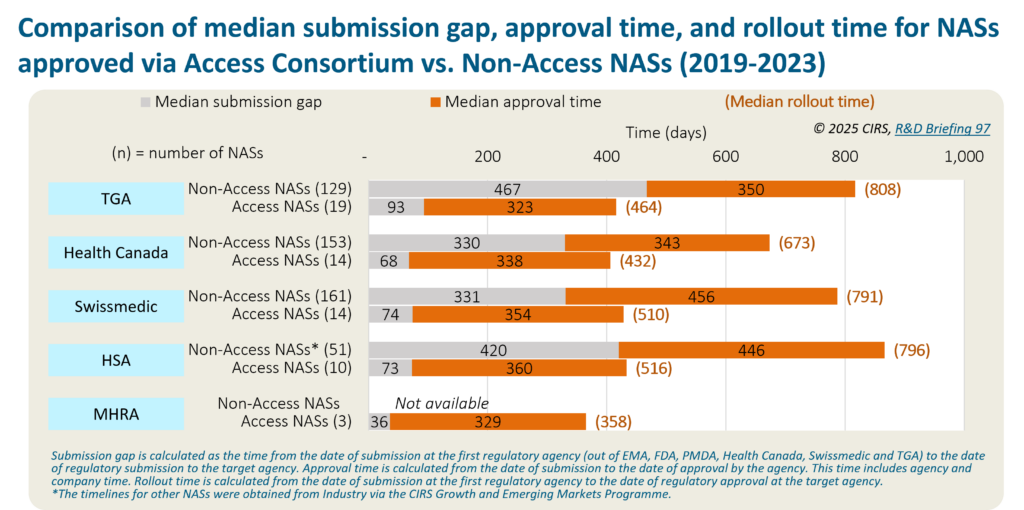
Collaborative regulatory models – including reliance, work sharing and collaborative review – are now a standard part of the regulatory toolkit and have reshaped how agencies work together to evaluate and approve medicines. Many of our workshops and R&D Briefings over the last decade have focused on understanding the impact of these models and sharing best practices. For example, new active substance (NAS) data from R&D Briefing 97 shows that Access work sharing is helping to reduce submission gaps to participating regulatory agencies, suggesting that there are efficiency gains (see below).
Single global development and submission
The aspiration for a single integrated development programme that allows simultaneous global submission remains a work in progress. While harmonisation efforts via the International Council for Harmonisation of Technical Requirements for Pharmaceuticals for Human Use (ICH) (as shown in this 2024 CIRS study commissioned by ICH) have contributed a great deal to the achievement of this vision, regulatory requirements, processes and timelines still vary globally. Our data shows that company submission strategies continue to prioritise the FDA followed by EMA, with increasing integration of growth and emerging markets, such as China and Brazil, reflecting a shift towards truly global development planning.
Sustaining the vision: CIRS’s commitment to collaborative policy making
The 2004 Tokyo workshop laid out a bold vision for the future of drug development and regulatory review, with emphasis on collaboration, flexibility and data-driven decision making. Many of its recommendations including rolling reviews, facilitated pathways, joint assessments, and real-time data sharing, have since been realised or are actively shaping current practices. Yet the aspiration for a truly integrated, globally harmonised development and review process remains a work in progress, particularly as emerging markets and new technologies reshape the regulatory landscape.
As the regulatory environment continues to evolve, CIRS remains committed to facilitating forward-thinking dialogue through multi-stakeholder workshops informed by our collaborative research. By fostering shared understanding and alignment, we help to identify policy solutions such as those articulated in R&D Briefing 44 that can be implemented or further refined to support responsive, forward-looking, and patient-focused medicines development globally.