
As companies navigate diverse global HTA environments, new CIRS analysis provides timely evidence on the role of parallel regulatory/HTA submissions.

Our latest publication in the International Journal of Technology Assessment in Health Care examined 229 HTA appraisals of new active substances between 2019-2023 by the Pharmaceutical Benefits Advisory Committee (PBAC) in Australia and Canada’s Drug Agency (CDA-AMC).

The study explored how parallel regulatory/HTA submissions compared with traditional sequential approaches — and what this means for rollout times and first HTA recommendations.

Key findings include:

  • Parallel submissions were associated with a 14‑month shorter rollout time from regulatory submission to first HTA recommendation.
  • Parallel submissions were associated with higher odds of receiving an optimal first HTA recommendation (defined as a positive or positive with restrictions recommendation).
  • In Australia, parallel submissions presented significantly faster listings on the Pharmaceutical Benefits Scheme (PBS) compared to sequential submissions.

These findings highlight the value of aligning regulatory and HTA processes. Parallel submissions should be considered by companies seeking to improve the efficiency of their market access strategies, as well as regulatory and HTA agencies looking to accelerate patient access in their jurisdiction.
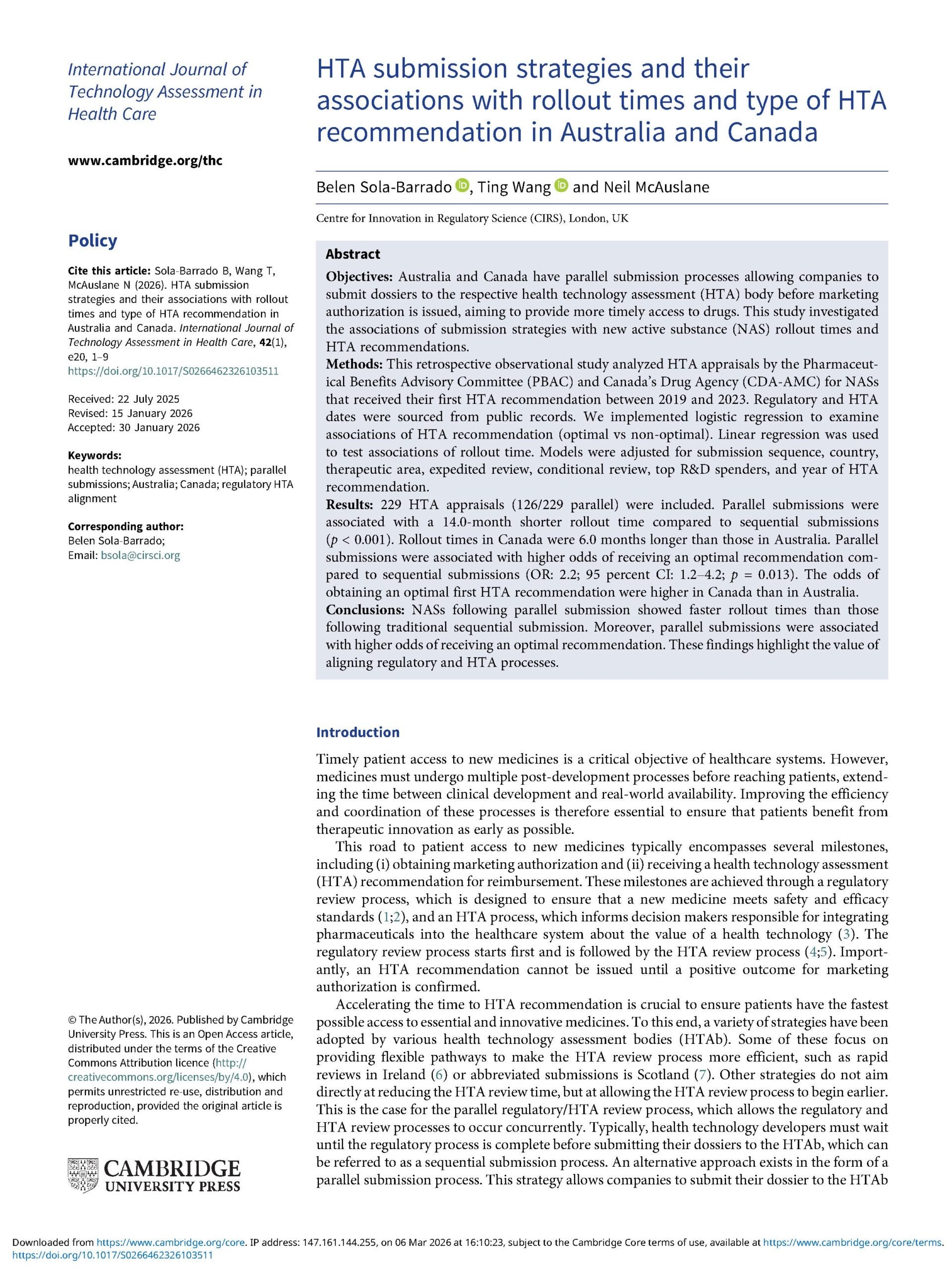
Objectives: Australia and Canada have parallel submission processes allowing companies to submit dossiers to the respective health technology assessment (HTA) body before marketing authorization is issued, aiming to provide more timely access to drugs. This study investigated the associations of submission strategies with new active substance (NAS) rollout times and HTA recommendations.

Methods: This retrospective observational study analyzed HTA appraisals by the Pharmaceutical Benefits Advisory Committee (PBAC) and Canada’s Drug Agency (CDA-AMC) for NASs that received their first HTA recommendation between 2019 and 2023. Regulatory and HTA dates were sourced from public records. We implemented logistic regression to examine associations of HTA recommendation (optimal vs non-optimal). Linear regression was used to test associations of rollout time. Models were adjusted for submission sequence, country, therapeutic area, expedited review, conditional review, top R&D spenders, and year of HTA recommendation.

Results: 229 HTA appraisals (126/229 parallel) were included. Parallel submissions were associated with a 14.0-month shorter rollout time compared to sequential submissions (p < 0.001). Rollout times in Canada were 6.0 months longer than those in Australia. Parallel submissions were associated with higher odds of receiving an optimal recommendation compared to sequential submissions (OR: 2.2; 95 percent CI: 1.2-4.2; p = 0.013). The odds of obtaining an optimal first HTA recommendation were higher in Canada than in Australia.

Conclusions: NASs following parallel submission showed faster rollout times than those following traditional sequential submission. Moreover, parallel submissions were associated with higher odds of receiving an optimal recommendation. These findings highlight the value of aligning regulatory and HTA processes.

Sola-Barrado B, Wang T, McAuslane N. HTA submission strategies and their associations with rollout times and type of HTA recommendation in Australia and Canada. Int J Technol Assess Health Care. 2026;42(1):e20. Published 2026 Feb 9. doi:10.1017/S0266462326103511