
This journal article co-authored by CIRS, AUDA‑NEPAD, the African Medicines Agency (AMA), and University of Hertfordshire, reviews the development of the African Medicines Agency (AMA), tracing its evolution from the early harmonisation efforts of the African Medicines Regulatory Harmonisation (AMRH) initiative through to the establishment of the AMA Treaty and the agency’s phased implementation plan.

The article highlights:

  • The historical and legal foundations of AMA
  • Its governance structure and institutional framework
  • The role of national regulatory authorities (NRAs), regional economic communities (RECs) and other stakeholders in strengthening Africa’s regulatory ecosystem
  • Key insights from the Continental Listing Pilot
  • Challenges and future opportunities as AMA moves toward full operationalisation.

Without doubt, AMA represents a significant milestone in Africa’s journey toward regulatory harmonisation, improved access to quality-assured medicines, and strengthened public health systems. CIRS remains committed to supporting the African regulatory community on this journey through the work of the Optimising Efficiencies in Regulatory Agencies (OpERA) Programme, as well as contributing to global conversations on regulatory convergence, reliance pathways and system strengthening.
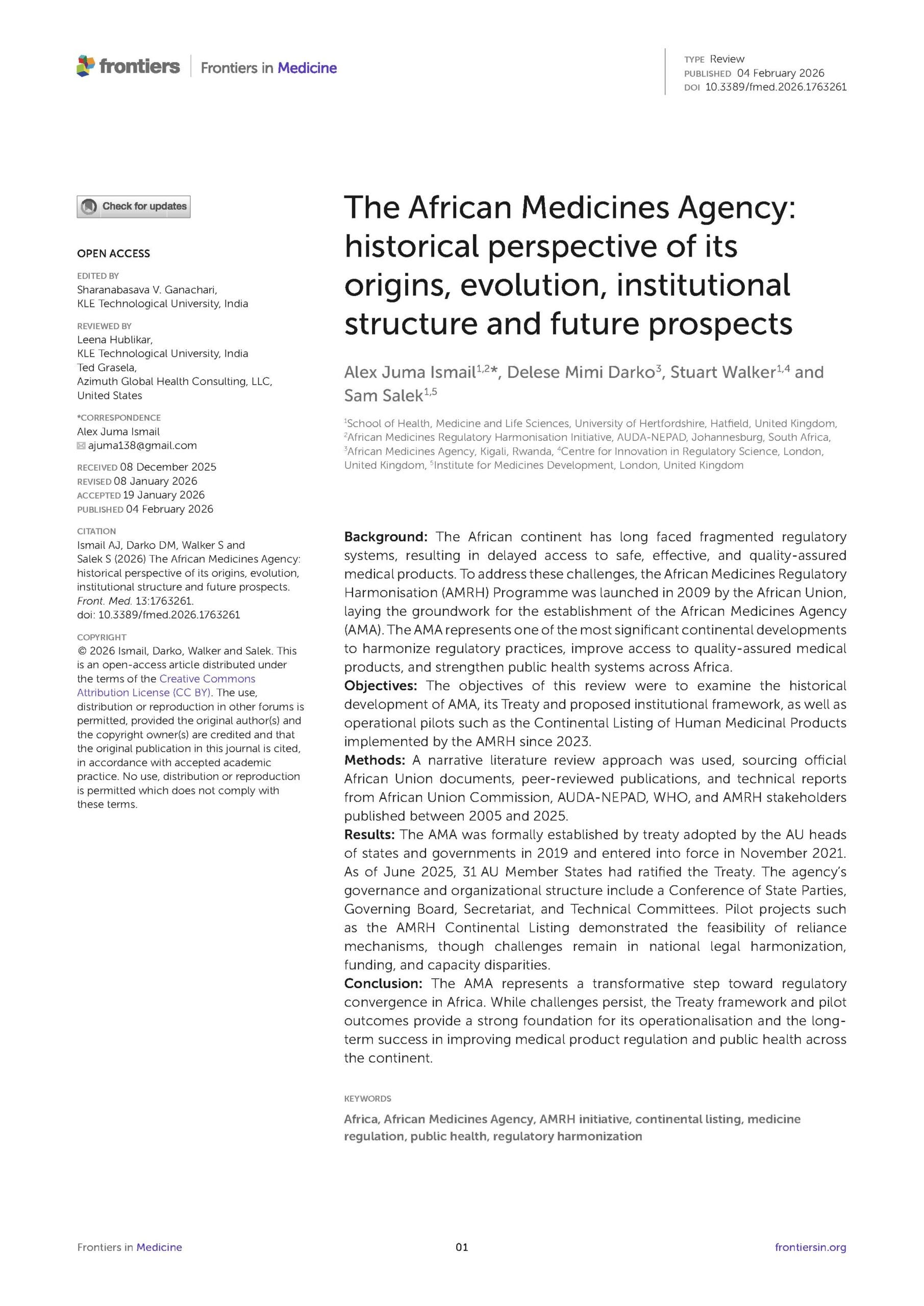
Background

The African continent has long faced fragmented regulatory systems, resulting in delayed access to safe, effective, and quality-assured medical products. To address these challenges, the African Medicines Regulatory Harmonisation (AMRH) Programme was launched in 2009 by the African Union, laying the groundwork for the establishment of the African Medicines Agency (AMA). The AMA represents one of the most significant continental developments to harmonise regulatory practices, improve access to quality-assured medical products, and strengthen public health systems across Africa.

Objectives

The objectives of this review were to examine the historical development of AMA, its Treaty and proposed institutional framework, as well as operational pilots such as the Continental Listing of Human Medicinal Products implemented by the AMRH since 2023.

Methods

A narrative literature review approach was used, sourcing official African Union documents, peer-reviewed publications, and technical reports from African Union Commission, AUDA-NEPAD, WHO, and AMRH stakeholders published between 2005 and 2025.

Results 

The AMA was formally established by treaty adopted by the AU heads of states and governments in 2019 and entered into force in November 2021. As of June 2025, 31 AU Member States had ratified the Treaty. The agency’s governance and organisational structure include a Conference of State Parties, Governing Board, Secretariat, and Technical Committees. Pilot projects such as the AMRH Continental Listing demonstrated the feasibility of reliance mechanisms, though challenges remain in national legal harmonisation, funding, and capacity disparities.

Conclusion

The AMA represents a transformative step toward regulatory convergence in Africa. While challenges persist, the Treaty framework and pilot outcomes provide a strong foundation for its operationalisation and the long-term success in improving medical product regulation and public health across the continent.

Ismail AJ, Darko DM, Walker S and Salek S (2026) The African Medicines Agency: historical perspective of its origins, evolution, institutional structure and future prospects. Front. Med. 13:1763261. doi: 10.3389/fmed.2026.1763261